
Army officials in Leh were a part of a meeting convened by the Jammu and Kashmir government that agreed that China was encroaching into the land with "specific design" to grab a particular area to extend its control till Indus river.

The Cabinet Committee on Security (CCS) met on Wednesday under the chairmanship of Prime Minister Narendra Modi and firmed up the responses to the terror attack.

The sources said India has always been a steadfast supporter and a responsible partner in implementing the IWT in letter and spirit.
In a first since the signing of the Indus Water Treaty between the two countries, three female officers will also be part of the Indian delegation, which will be advising the Indian Commissioner on various issues during the meeting, the official said.
The talks as part of the annual Permanent Indus Commission meeting are being held after a gap of over two years.

Pakistan has responded to a letter by India asking to start negotiations for the review of the Indus Water Treaty, the foreign office said on Wednesday.

Floodwaters from the Ravi River have inundated the Kartarpur Corridor in Pakistan, including Gurdwara Darbar Sahib, stranding over 100 people. Rescue operations are underway as thousands are evacuated from flooded areas.
"I do not think they (World Bank) are in a position to interpret the treaty for us. It is a treaty between our two countries and our assessment of the treaty is that there is a provision of graded approach," External Affairs Ministry Spokesperson Arindam Bagchi said.
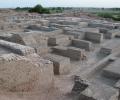
Scientists have found that much of the Indus civilisation thrived around an extinct river, challenging ideas about how urbanisation in ancient cultures evolved.
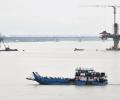
'China could intentionally release excess water.' 'The North East is already flood-prone during the monsoon, and even a controlled release from Chinese dams (during the monsoon) could worsen flooding.'

Emboldened by the international court of justice's interim ruling on the Kishenganga project, Pakistan now plans to take the Nimoo-Bazgo hydropower project being built by India on the Indus river to the world court, according to media reports.
The Standing Committee on Water Resources has recommended renegotiating the Indus Water Treaty with Pakistan to address the impact of climate change on water availability in the river basin and other challenges which are not covered under the agreement.

India has issued a strong warning to Pakistan against continuing its 'hateful' rhetoric and any potential misadventures, following recent nuclear threats and remarks from Pakistani leadership.
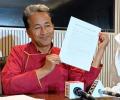
Wangchuk rued that over the years, glacial ice has been receding but action remains delayed.

'Archaeological sites like Keeladi, having remained buried for 2,500 years, have come out and speak now.'

Prime Minister Narendra Modi asserted on Tuesday that India's water will no longer flow outside the country but will be utilized in the nation's interest, a statement seemingly directed at Pakistan following his government's decision to put the Indus Waters Treaty in abeyance after the Pahalgam terror attack. Addressing the ABP Network's 'India@2047' Summit, Modi emphasized his government's focus on interlinking rivers, noting that water used to be a source of conflict among states, before alluding to India's stance against Pakistan while discussing water. He highlighted the finalization of the India-UK free trade agreement as a historic milestone and underscored the importance of prioritizing national interest for achieving objectives and realizing the country's potential. Modi highlighted the country's growth and development under his government's rule, emphasizing its focus on welfare schemes and digitalization. He reiterated his government's commitment to 'Nation First' and pointed to the recent reforms undertaken, including the new Waqf law and the ban on triple talaq, which he said were aimed at benefiting the marginalized sections of society.

He clarified that though China has not announced any such move, but even if it happens, it would in fact help mitigate the annual Assam floods.

On November 18, 1962, 114 soldiers of the 13th Kumaon fought till the last man, and last bullet, in sub-zero temperatures, to beat back the huge Chinese army. We salute the Heroes of Rezang La.

'At Keeladi, we have not come across any evidence for organised religion.'

It is important for India to pay close attention to both the tone and substance of authoritative remarks coming out of Pakistan, explains former foreign secretary Shyam Saran.

Former Pakistan foreign minister Bilawal Bhutto had acknowledged his country's tango with terror operatives, saying that Pakistan has a past.

The Indian Army is one of the very few armies in the world that operates tanks at high altitudes up to 16,000 feet, and in large numbers.

A simple explainer to the Indus Water Treaty.

The World Bank's move came as it told the two countries that it was responding to their separate proceedings initiated under the Indus Waters Treaty 1960.

The talks will be the first official engagement between India and Pakistan since Khan became prime minister on August 18.

Modi said India has now established a "new normal" of not differentiating between terrorists and those who nurture terrorism as they are both enemies of humanity.
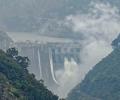
India's measures announced against Pakistan on April 23 will remain effective, the sources said.

'You can be sure that the Pakistanis knew when the Indian Air Force aircraft took off, which type these were, and what their likely targets were.' 'The question was: How would they determine that the IAF wanted to fire, and when to bounce them?', notes Shekhar Gupta.

Pakistan's Deputy Prime Minister and Foreign Minister Ishaq Dar has warned India of a strong response, saying Pakistan will respond to a "brick with a stone" if India takes any action against Pakistan, amid heightened tensions following the April 22 terror attack in Jammu and Kashmir's Pahalgam. Dar alleged that India might have staged the Pahalgam attack to abolish the Indus Waters Treaty (IWT) and warned that any attempt by India to interfere with the treaty would be considered an act of war. He also said that Pakistan had no involvement in the Pahalgam incident and is getting support from countries like Saudi Arabia, China, the United Arab Emirates, the United Kingdom, Kuwait, Bahrain, and Hungary.

The exchange of fire occurred even though the directors general of military operations of India and Pakistan spoke over the hotline on Tuesday amid rising tensions between the two countries over the Pahalgam terror attack on April 22.

Pakistan's ambassador to Russia, Muhammad Khalid Jamali, has warned that Pakistan will respond with "full spectrum of force", including nuclear, if it is attacked or its vital water flow is disrupted. The warning comes amid heightened tensions between Pakistan and India following a terrorist attack in Jammu and Kashmir. Jamali also reiterated Pakistan's stance on the Indus Water Treaty, saying any attempt to stop or divert water flow would be considered an act of war. He urged de-escalation, emphasizing the potential danger given both countries possess nuclear weapons. Jamali further called for a neutral investigation into the Kashmir attack, suggesting the involvement of China and Russia. He also highlighted the need to address the root causes of the conflict, pointing to the unresolved Kashmir issue and its potential for resentment.

Pakistan troops have violated the ceasefire agreement for the 11th consecutive night, firing on Indian posts along the Line of Control (LoC) in Jammu and Kashmir. The firing began in Kupwara and Baramulla districts and spread to other sectors, including Poonch, Rajouri, Mendhar, Naushera, Sunderbani, and Akhnoor. The Indian Army responded promptly and proportionately. The ceasefire violation comes despite a recent phone call between the Directors General of Military Operations (DGMOs) of India and Pakistan on April 29. This marks the latest escalation of tensions between the two countries, following a terror attack in Pahalgam in April.

Experts say the treaty needs a review to address the ongoing and the likely impact of climate change on river-flow
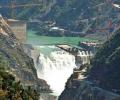
This will be the annual meeting of the Permanent Indus Commission. Under the provisions of the Indus Water Treaty, both the commissioners are required to meet at least once a year alternately in India and Pakistan.
Pakistan has raised objections to the design of India's Kiru hydroelectric plant, a mega 624 MW project over the Chenab river in Jammu and Kashmir, but New Delhi asserts that the project is fully compliant with the Indus Water Treaty, according to officials.

The statement of the Minister of State in the Prime Minister's office comes on the heels of India issuing a notice to Pakistan seeking a review and modification of the IWT in view of Islamabad's "intransigence" in complying with the dispute redressal mechanism of the pact that was inked over six decades ago for sharing of waters of cross-border rivers.

For the ninth consecutive night, Indian and Pakistani troops engaged in small arms fire along the Line of Control (LoC) in Jammu and Kashmir, continuing a pattern of heightened border tensions. The skirmishes, initiated by Pakistani troops in violation of the ceasefire agreement, have led to a tense situation along the LoC and International Border (IB). The incidents come in the wake of the April 22 terror attack in Pahalgam, which claimed the lives of 26 people, mostly tourists. Civilians residing near the border have begun preparing their bunkers, anticipating potential escalation. Despite a recent hotline conversation between the Directors General of Military Operations (DGMOs) of India and Pakistan, where India cautioned Pakistan, the ceasefire violations persist.

Amid growing strain in India-Pakistan ties, the government is planning to fast-track four projects in Indus river basin to increase irrigation area in Jammu and Kashmir by nearly 2.05 lakh acres, weeks after India decided to "exploit to the maximum" the water of Pakistan-controlled rivers, including Jhelum, as per Indus Water Treaty.
Terrorism and insurgency in J&K had subsided when India demolished East Pakistan -- for the simple reason that Pakistan understands power. We need to follow Chanakya's dictum of Saam, Daam, Dand, Bhed for strategising against Pakistan, asserts Lieutenant General Prakash Katoch (Retd). The ground truth is that unless we are prepared to acknowledge our shortcomings, including massive intelligence failures, punish those responsible and take corrective actions, we will continue in the same vein, asserts Lieutenant General Prakash Katoch (Retd).

"The treaty has caused huge loss to Jammu and Kashmir" as the people of the state cannot fully utilise the waters of various rivers, particularly Chenab in Jammu, for agricultural and other activities, Singh said.
